How to Build an Intelligent Multi-Model Routing Architecture: The
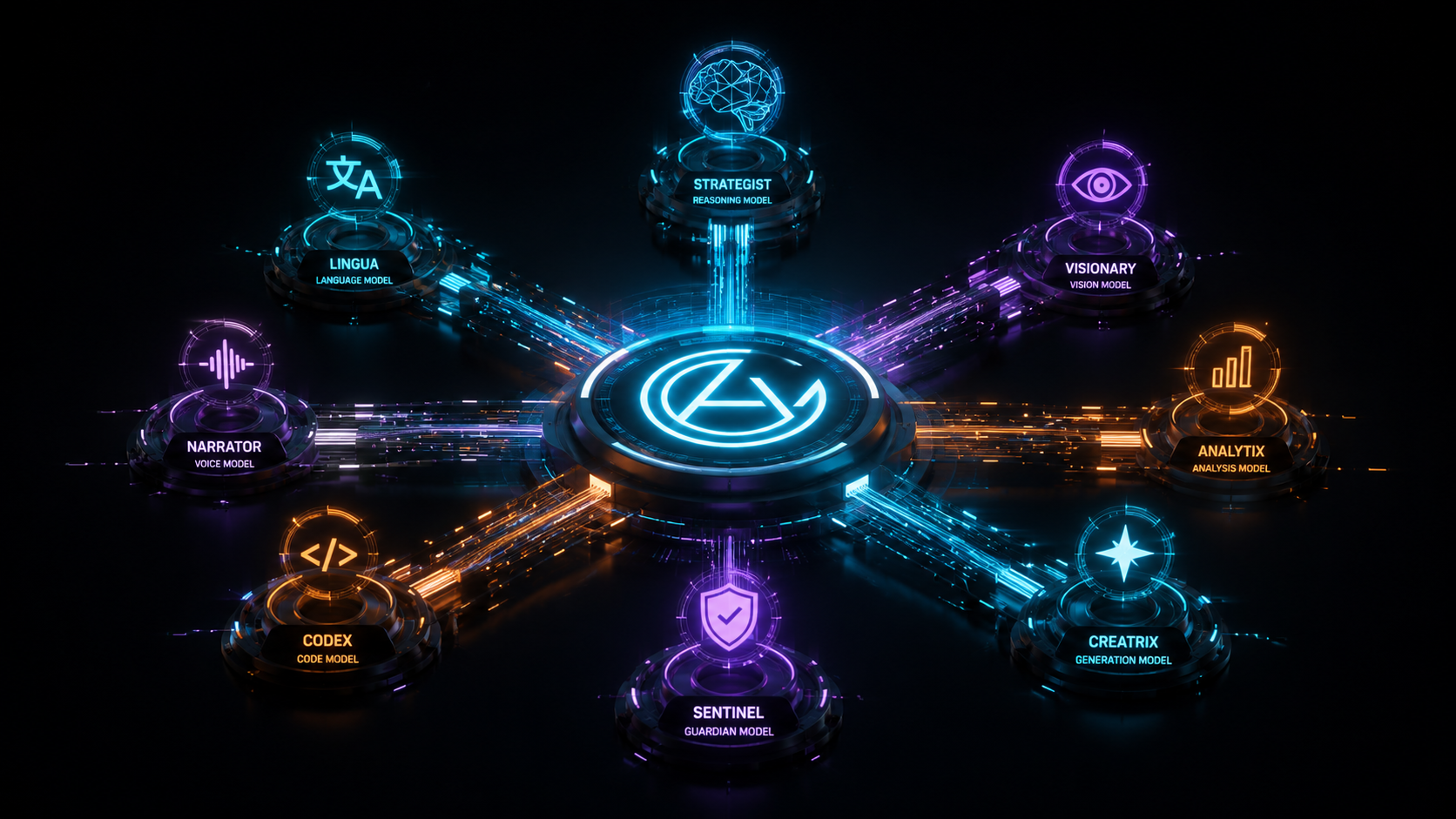
I used to believe that one flagship model could handle everything. Pick the highest-scoring model on the benchmark leaderboard, route every request through it, and call the architecture complete. That belief collapsed the moment I ran our production AhteVerse pipelines under real-world load for a full quarter.
The reasoning model I trusted for deep code refactoring was burning through token budgets on trivial classification tasks that a model one-tenth its size could handle in milliseconds. The fast autocomplete model I relied on for speed was hallucinating dangerously when I pushed complex multi-file architectural changes through it. Every task was hitting the wrong model, and the system was bleeding both money and quality simultaneously.
That failure taught me the most important infrastructure lesson of 2026: the model is not the product. The router is the product. Here is the full developer blueprint for building intelligent multi-model routing architectures that dispatch every task to the right model at the right cost.
Conceptual Architecture Blueprint
graph TD
    Malicious["Prompt Injection Vector"] -->|Threat| Input["Raw Agent Input Node"]
    Input -->|Sanitization Filter| Shield("Vector Guard Sanitizer")
    Shield -->|Clean Context| LLM("Neural Processing Core")
    LLM -->|Secure Output| Execute["Autonomous Function Execution"]

    classDef secure fill:#1a3a2a,stroke:#00ff66,stroke-width:2px,color:#fff;
    classDef threat fill:#3a1a1a,stroke:#ff3333,stroke-width:2px,color:#fff;
    class Input threat;
    class Shield secure;
The Single-Model Trap: Why Monolithic Dispatch Fails
Let me be direct about why the single-model architecture collapses at production scale. Every foundation model occupies a specific position on a three-dimensional tradeoff surface: intelligence, latency, and cost-per-token. No single model dominates all three dimensions simultaneously.
Frontier reasoning models like Claude Opus or Gemini Ultra deliver exceptional intelligence on complex tasks, but they carry high per-token costs and elevated latency due to extended chain-of-thought processing. Lightweight models like Gemini Flash or distilled open-weight variants execute in sub-second timeframes at fractional cost, but they degrade sharply on multi-step reasoning, nuanced code generation, or tasks requiring deep contextual awareness.
When you route every request through a single model, you are forcing one point on that tradeoff surface to serve the entire spectrum of your workload. Simple tasks get over-served (wasting budget on intelligence they do not need), while complex tasks get under-served (receiving insufficient reasoning depth). The result is a system that is simultaneously too expensive and too unreliable.
The solution is not a better model. The solution is a routing layer that maps every incoming task to the optimal point on the tradeoff surface.
The Router Pattern: Infrastructure Gateway vs. Intelligence Layer
Production-grade multi-model systems implement a two-layer architecture. Understanding this separation is critical before writing a single line of routing logic.
The first layer is the Infrastructure Gateway. This handles model-agnostic concerns: API key management, rate limiting, request logging, cost tracking, PII redaction, and retry logic with exponential backoff. The gateway normalizes all provider-specific API formats into a unified internal interface, so your application code never couples to a specific provider's SDK. Tools like LiteLLM or custom OpenRouter-compatible wrappers serve this role. If a provider goes down, the gateway handles failover transparently without touching your routing logic.
The second layer is the Intelligent Router. This is where the strategic value lives. The router evaluates each incoming request against a set of configurable policies and dispatches it to the optimal model. The gateway handles the plumbing. The router handles the decisions. Conflating these two concerns is the most common architectural mistake I see in production deployments. For a comprehensive overview of how modern gateway architectures standardize multi-provider access, developers should review the official LiteLLM Unified API Documentation.
Five Production Routing Strategies
After building and iterating on routing systems inside the AhteVerse, I have converged on five core strategies that cover the full spectrum of production workloads.
Strategy 1: Complexity-Gated Routing
This is the most cost-effective pattern and the one I recommend implementing first. Every incoming request hits a lightweight classifier (which can be a small, fine-tuned model or even a rule-based heuristic) that estimates task complexity on a simple scale.
Low-complexity tasks (classification, extraction, summarization of short text, simple Q&A) get routed to the cheapest, fastest available model. High-complexity tasks (multi-file code refactoring, legal document analysis, multi-step mathematical reasoning) get escalated to the frontier reasoning model. The key discipline is setting the complexity threshold correctly. Too aggressive, and you send hard tasks to weak models. Too conservative, and you waste budget on over-qualified models for trivial work.
The advanced variant is confidence-gated fallback. The cheap model processes every request first. If its output confidence score falls below a configurable threshold, the system automatically re-routes the same request to the frontier model. This guarantees quality on hard tasks while keeping costs minimal on easy ones.
Strategy 2: Domain-Specialist Routing
Different models excel at different domains. Some models dominate code generation benchmarks. Others lead on creative writing, mathematical proofs, or multilingual translation. Domain-specialist routing leverages this natural specialization.
The router classifies the incoming request by domain (code, prose, data analysis, conversation) and dispatches it to the model with the highest validated performance in that domain. Inside our AhteVerse pipelines, code generation tasks route to one model while content drafting routes to another. Each model operates in its zone of maximum competence.
Strategy 3: Latency-Optimized Routing
For user-facing applications where response time directly impacts experience, the router must factor in real-time latency measurements. This strategy maintains a live latency table for each model endpoint, updated continuously through health check pings.
When latency constraints are tight (interactive chat, real-time autocomplete), the router selects the model with the lowest current p95 latency that meets the minimum quality threshold. When latency constraints are relaxed (background batch processing, offline analysis), the router selects the highest-quality model regardless of response time.
Strategy 4: Cost-Budget Routing
This strategy enforces hard financial boundaries. The router tracks cumulative token spend across all models in real-time. When the budget utilization approaches a configurable threshold (say 80% of the monthly allocation), the router automatically begins downgrading requests to cheaper models, preserving the remaining budget for critical tasks that genuinely require frontier intelligence.
This prevents the catastrophic cost overruns that plague teams who deploy powerful models without spending governance. In the AhteVerse, we treat token budgets with the same discipline as cloud compute budgets. Every token must justify its cost.
Strategy 5: Consensus Routing
For mission-critical outputs where correctness is non-negotiable (financial calculations, medical information, security-sensitive code), consensus routing dispatches the same request to multiple models simultaneously. The outputs are compared programmatically. If all models agree, the response is served. If they diverge, the system flags the response for human review or routes it to the most authoritative model for a tiebreaker pass.
This is the most expensive strategy and should only be applied to high-stakes decision points. But for outputs where a single hallucination could cause real damage, the cost of multi-model consensus is trivial compared to the cost of an incorrect deployment.
Building the Routing Matrix: Your Custom Decision Table
Generic benchmark leaderboards are useful starting points, but they will not tell you which model performs best on your specific workload distribution. The most valuable asset in any multi-model system is a custom Routing Matrix built from your own production data.
The process is straightforward. Log every request that passes through your system with three metadata fields: the task classification, the model that processed it, and a quality score (either automated or human-evaluated). After accumulating sufficient data (typically two to four weeks of production traffic), analyze the distribution. You will discover that your workload clusters into a small number of distinct task types, and that different models consistently outperform on different clusters.
This empirical routing matrix replaces guesswork with data. Update it monthly as new models launch and existing models receive updates. Your routing logic should read from this matrix at runtime, making the system trivially updatable without code changes. For frameworks that implement dynamic routing policies with built-in evaluation loops, developers should study the Anthropic Prompt Routing Architecture Guide.
The Observability Plane: Tracing Across Models
In a single-model system, debugging is simple. In a multi-model system, a single user request might touch three different models across two providers. Without distributed tracing, debugging failures becomes impossible.
Every request must carry a unique trace ID that propagates through the gateway, the router, and the model provider. Log the routing decision (which model was selected and why), the raw latency, the token consumption, and the quality score for every single request. This observability plane is not optional infrastructure. It is the only mechanism that allows you to audit routing decisions, identify quality regressions, and optimize cost allocation over time.
Build dashboards that surface three key metrics in real-time: cost-per-quality-point (are you getting cheaper without losing quality?), routing distribution (what percentage of requests go to each model?), and fallback rate (how often does the confidence gate trigger escalation?). These three numbers tell you the health of your entire routing architecture at a glance.
The Sovereignty Argument
There is a deeper strategic reason to build your own routing layer rather than relying on a single provider's hosted solution.
When you hard-couple your application to one model provider, you are placing your entire product quality at the mercy of their pricing decisions, their deprecation schedules, and their uptime reliability. If that provider raises prices by 40% overnight (which has happened), your unit economics collapse. If they deprecate the model version your prompts are optimized for (which happens regularly), your output quality degrades until you re-engineer your prompt library.
Owning your routing layer means owning your optionality. You can switch providers in minutes, not months. You can adopt new models the day they launch without rewriting your application. Your routing matrix and your prompt library become your strategic intellectual property, not disposable configurations tethered to a single vendor's API surface.
In the AhteVerse, we treat model providers as interchangeable compute nodes. The intelligence lives in the routing layer, the prompt engineering, and the evaluation loops. The models are fungible resources. That architectural posture is what gives us operational sovereignty.
Implementation Stack
Here is the concrete technology stack I recommend for building this architecture.
For the infrastructure gateway, start with LiteLLM or a custom OpenRouter-compatible proxy. This gives you unified API access to every major provider through a single interface, with built-in cost tracking, rate limiting, and retry logic.
For the intelligent router, build a lightweight Python service that reads from your routing matrix configuration and evaluates incoming requests against your policy rules. Keep the router stateless. All routing state (budget consumption, latency measurements, quality scores) should live in a shared Redis or PostgreSQL store that the router queries at request time.
For observability, instrument everything with OpenTelemetry. Propagate trace IDs from the application layer through the router and into the gateway. Export traces to a centralized backend for analysis and alerting.
For the evaluation pipeline, implement a scheduled batch job that samples recent production outputs, runs automated quality assessments, and updates your routing matrix. This closes the feedback loop, ensuring that your routing decisions improve continuously based on real-world performance data.
The Road Ahead
The era of monolithic model deployment is ending. The developers and teams who build intelligent routing layers today are building the infrastructure that will compound in value as the model landscape continues to fragment and specialize.
Every new model release becomes an opportunity rather than a migration headache. Every pricing change becomes a routing adjustment rather than a budget crisis. Every quality improvement in a niche model gets automatically captured by your domain-specialist routing logic.
Build the router. Own the routing matrix. That is how you build AI systems that are resilient, cost-efficient, and permanently model-agnostic.
We are initialized.