Mastering ai agent persistent memory architecture: How to Build
I used to believe that bigger context windows would solve everything. Feed the model more tokens, and it remembers more. That hypothesis collapsed the moment I deployed a long-running agent that contradicted its own decisions from three hours earlier. The context window had not shrunk. The information was technically still in there. But the model had effectively forgotten it, buried under layers of newer, noisier tokens.
That failure taught me the most important architectural lesson in modern AI engineering: the context window is volatile RAM, not a hard drive. You would never build a production application that stores critical business state exclusively in RAM and expects it to survive a power cycle. Yet that is exactly what most AI agent deployments do today.
Here is the full developer blueprint for building persistent, multi-tier memory systems that give AI agents genuine recall. This is the architecture the industry is converging on in 2026, and it is the architecture we are building inside the AhteVerse.
Conceptual Architecture Blueprint
sequenceDiagram
    participant User as Sovereign User
    participant Wallet as DID Identity Wallet
    participant Verifier as Decentralized Verifier
    participant Ledger as Immutable Ledger

    User->>Wallet: Request cryptographic proof
    Wallet->>Verifier: Send Zero-Knowledge proof (ZKP)
    Verifier->>Ledger: Verify anchor hash state
    Ledger-->>Verifier: Return state confirmation
    Verifier-->>User: Grant sovereign access
The Goldfish Problem: Why Context Windows Fail
Let me be direct about the failure mode. A context window, regardless of whether it holds 128K or 2 million tokens, has three fundamental limitations that make it unsuitable as a memory system.
First, quadratic cost scaling. Attention mechanisms scale quadratically with sequence length. Doubling your context window does not double your compute cost. It roughly quadruples it. At production scale, simply stuffing more historical data into the prompt becomes economically unsustainable.
Second, the Lost-in-the-Middle problem. Research has consistently demonstrated that language models degrade in their ability to retrieve and reason over information buried in the middle of long contexts. The first and last portions of the context window get disproportionate attention. Everything else enters a retrieval dead zone.
Third, no state evolution. Context windows are static snapshots. They cannot natively handle fact updates. If a user changes their address, or a project status shifts from active to completed, the context window has no mechanism to invalidate the old fact and promote the new one. You end up with contradictions coexisting in the same prompt.
These are not edge cases. These are the default failure modes of every agent that treats the context window as its primary memory store.
The Multi-Tier Memory Architecture
The solution is to stop thinking of AI memory as a single bucket and start thinking of it as a layered system, exactly the way computer science has always solved the speed-versus-capacity tradeoff.
Here is the four-tier model that production-grade agent systems are converging on.
Tier 1: Working Memory (The Context Window)
This is your L1 cache. It is fast, expensive, and volatile. The context window should hold only the information required for the immediate task: the current user message, relevant retrieved context, active tool calls, and the agent's current reasoning trace.
The discipline here is ruthless pruning. Every token in working memory should earn its place. If a piece of information is not directly relevant to the current inference step, it does not belong here.
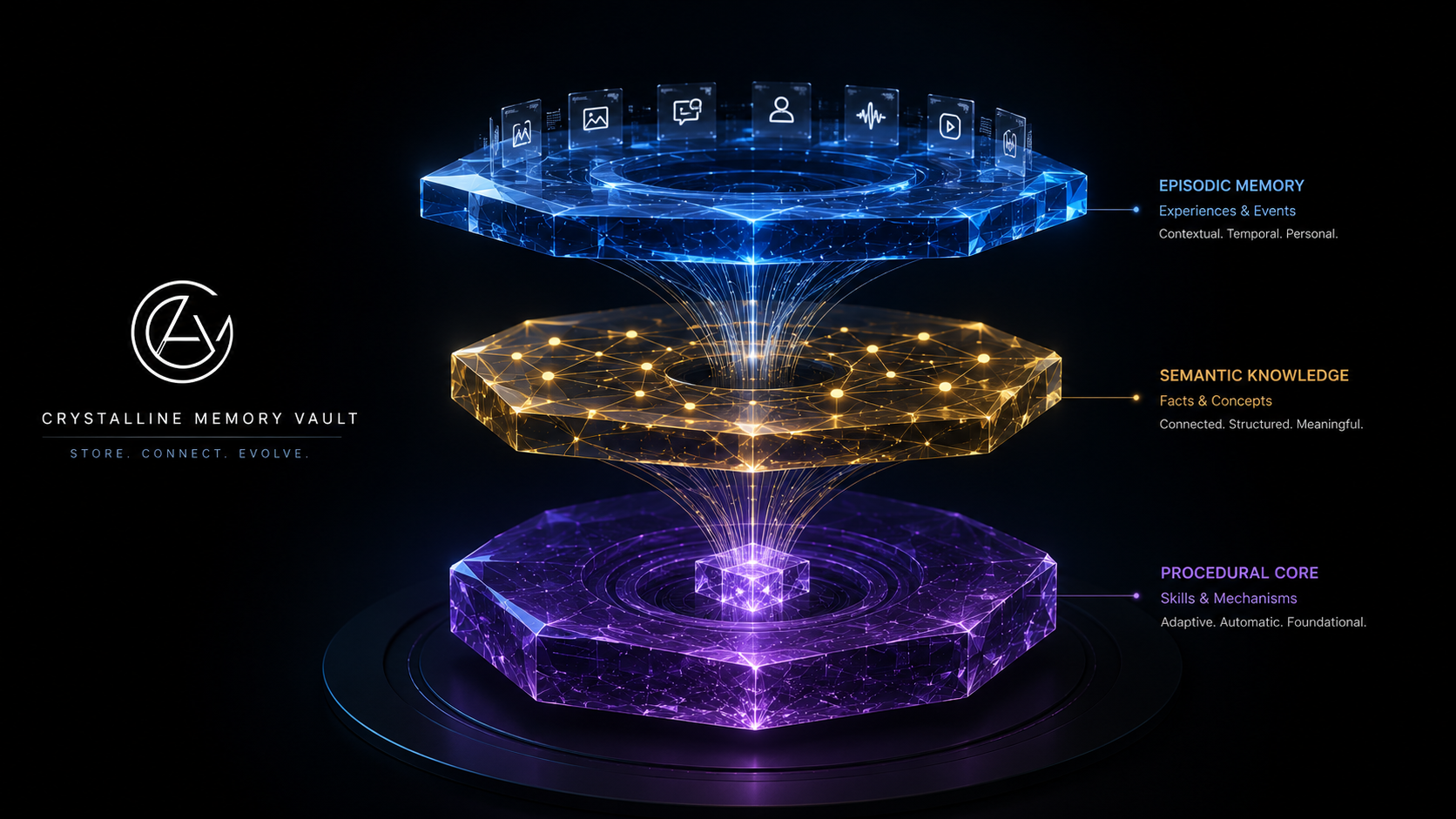
Tier 2: Episodic Memory (The Event Log)
Episodic memory is a time-indexed record of specific interactions, decisions, and outcomes. Think of it as the agent's autobiography: a chronological ledger of what happened, when it happened, and what the result was.
The implementation pattern is straightforward. Use PostgreSQL with the pgvector extension for hybrid structured-plus-vector queries. Each episodic entry gets a timestamp, a session identifier, an embedding vector, and a structured metadata payload.
The retrieval pattern is equally important. When the agent starts a new session, it queries episodic memory for the most recent and most relevant past interactions with the current user or project. Those summaries get injected into working memory as context priming.
Tier 3: Semantic Memory (The Knowledge Graph)
Semantic memory stores facts, preferences, and entity relationships. This is where flat vector databases start to fail and graph-native structures become essential.
The critical difference is this: a vector database can tell you that two facts are semantically similar. A knowledge graph can tell you that two entities are causally connected, hierarchically related, or temporally sequenced. When an agent needs to reason about why a user prefers a specific deployment pattern or how two projects are architecturally related, semantic similarity alone is insufficient. You need structured relationships.
The implementation pattern uses a graph-vector hybrid. Nodes represent entities (users, projects, concepts, tools). Edges represent relationships (owns, depends-on, prefers, caused). Each node and edge also carries an embedding vector for semantic retrieval. This gives you the best of both worlds: structured traversal for precise queries and vector similarity for fuzzy, exploratory retrieval.
Tier 4: Procedural Memory (The Playbook)
Procedural memory is the most underbuilt and most impactful tier. It stores learned behaviors, best practices, and operational patterns. Think of it as the agent's muscle memory.
Examples: always run unit tests before committing. When deploying to staging, check the environment variables first. When the user asks about pricing, retrieve the latest pricing sheet before responding.
These are not facts. They are behavioral policies. The implementation pattern stores them as structured rule objects with trigger conditions, action sequences, and confidence scores. When the agent encounters a situation that matches a trigger condition, it retrieves the corresponding procedural memory and incorporates it into its planning step.
This is where agents stop being reactive text generators and start behaving like experienced operators.
The Dreaming Pipeline: Memory Consolidation
Having four memory tiers is necessary but not sufficient. The critical missing piece in most architectures is the consolidation process. The mechanism that transforms raw, noisy short-term data into clean, durable long-term knowledge.
I call this the Dreaming Pipeline because it mirrors the biological process of memory consolidation during sleep. It runs as a background process, typically on a daily or session-end cadence.
Phase 1: Ingestion (Light Sleep)
Collect all raw session transcripts, tool call logs, and decision traces from the past cycle. This is the unprocessed data stream from Tier 1 (Working Memory) that would normally be discarded when the session ends.
Phase 2: Reflection (REM Sleep)
This is where a separate LLM pass (or a dedicated smaller model) reviews the raw data and evaluates each piece of information against three criteria.
Relevance: Does this information have lasting value, or was it purely transient? A user asking about the weather during a debugging session is transient. A user expressing a strong preference for TypeScript over JavaScript is lasting.
Frequency: Has this pattern appeared before? Information that surfaces across multiple independent sessions is a strong signal for promotion.
Conceptual Richness: Does this information connect to or modify existing knowledge? A new fact that reinforces, contradicts, or extends an existing semantic node is more valuable than an isolated data point.
Only information that crosses a configurable threshold on these criteria gets promoted. Everything else is archived or discarded.
Phase 3: Promotion (Deep Sleep)
Promoted information is written into the appropriate long-term tier. New facts go to Semantic Memory. New behavioral patterns go to Procedural Memory. Time-indexed experiences go to Episodic Memory with distilled summaries replacing raw transcripts.
The key discipline here is deduplication and conflict resolution. If the new information contradicts an existing semantic node, the system must decide which version to keep based on recency, source authority, and confidence scoring. This is where most implementations fail silently. They accumulate contradictions instead of resolving them.
The Staleness Problem: Memory Decay
Persistent memory creates a new class of bugs that ephemeral context windows never had to deal with: staleness. An agent that remembers everything but never forgets or updates becomes increasingly dangerous as its knowledge base drifts from reality.
The solution is explicit memory decay. Every memory entry gets a confidence score that degrades over time unless reinforced by new evidence. Facts that have not been accessed or confirmed within a configurable window get flagged for review or automatic demotion.
This is not optional. This is a safety requirement. An agent confidently acting on outdated information is worse than an agent that admits it does not know.
Implementation Stack: What to Use
Here is the concrete technology stack that I recommend for building this architecture.
For the storage layer, start with PostgreSQL. It is ACID-compliant, battle-tested, and with pgvector you get native vector operations without needing a separate vector database. For the graph layer, use Apache AGE (a PostgreSQL extension) or Neo4j if your relationship complexity justifies a dedicated graph engine.
For the orchestration layer, use a framework that treats memory as a first-class tool. Letta provides OS-level virtual context management. Mem0 provides managed memory with built-in consolidation. If you need full control, build a custom layer using LangGraph or CrewAI with explicit memory tool definitions.
For the dreaming pipeline, implement it as a scheduled background job. A simple Python script running on a cron schedule that processes the day's episodic logs, runs the reflection pass, and writes promotions to the appropriate tier. This does not need to be complex. It needs to be reliable and consistent.
The Sovereignty Argument
There is a deeper strategic reason to build your own memory architecture rather than relying on a provider's built-in memory features.
When you use a managed memory service, your agent's accumulated knowledge, behavioral patterns, and user preferences live on someone else's infrastructure. If that provider changes their API, raises prices, or shuts down, your agent loses its entire cognitive history. That is an unacceptable dependency for any serious deployment.
Owning your memory stack means owning your agent's identity. The accumulated knowledge and learned behaviors are your intellectual property. They are what differentiate your agent from every other instance running the same foundation model. Building sovereign memory is not a technical preference. It is a strategic imperative.
The Road Ahead
The context window was never designed to be a memory system. It was designed to be a processing buffer. The sooner the industry fully internalizes this distinction, the sooner we stop building agents that forget and start building agents that learn.
The four-tier architecture I have outlined here is not theoretical. It is the operational pattern that the most capable agent systems in production are converging on right now. Working memory for immediate inference. Episodic memory for temporal context. Semantic memory for structured knowledge. Procedural memory for learned behavior. And a dreaming pipeline to consolidate, deduplicate, and evolve the entire system over time.
Build the memory. Own the memory. That is how you build AI systems that actually compound in value instead of resetting to zero every session.
We are just getting started.