Mastering how to use ai automate your week no
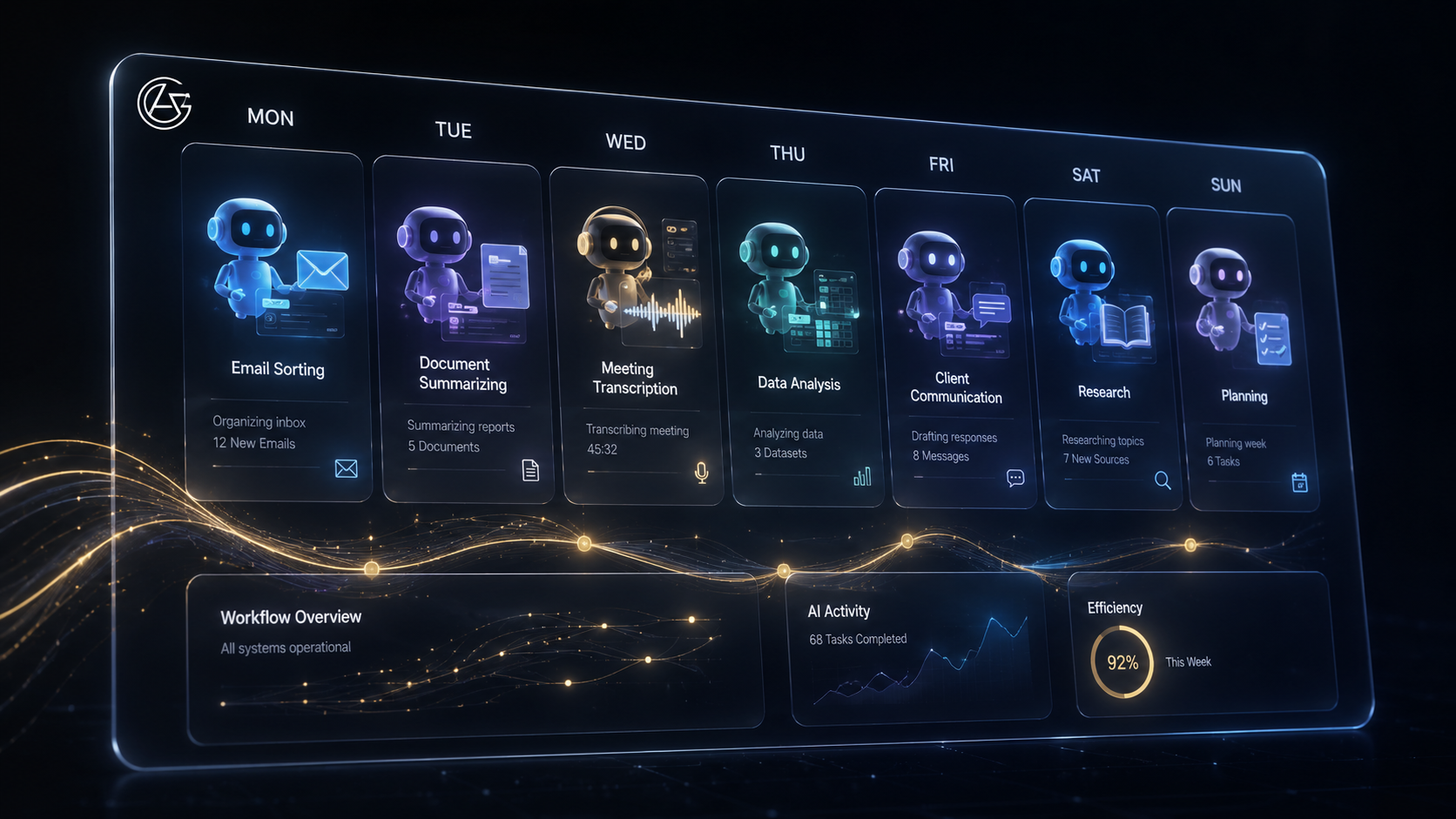
I spent the first six months of 2025 doing what most people still do with AI: treating it like a fancy search engine. I would open ChatGPT, ask a question, copy the answer, and close the tab. Occasionally I would ask it to rewrite an email. That was my entire relationship with the most powerful technology shift of our generation.
Then I actually tracked how I spent my time for two weeks. The results were brutal. I was burning over twelve hours every week on tasks that required zero creative thinking: sorting emails, summarizing meeting notes, reformatting documents, researching basic facts, writing repetitive follow-ups, and organizing information across scattered apps. None of this work required my brain. It required my hands and my patience. And I was running out of both.
That audit changed everything. I built a structured weekly system using free AI tools that now runs on autopilot. No coding. No technical background. No expensive subscriptions. Here is the exact blueprint.
Conceptual Architecture Blueprint
graph LR
    User["Trigger Event"] -->|Inbound Webhook| Gate("Active n8n Gateway")
    Gate -->|Cognitive Processing| Validator{"AI Validation Node"}
    Validator -->|Pass| CRM["Autonomous CRM Sync"]
    Validator -->|Fail| Alert["Slack Emergency Escalation"]

    classDef default fill:#111,stroke:#333,stroke-width:1px,color:#fff;
    classDef highlight fill:#1d2d44,stroke:#00e5ff,stroke-width:2px,color:#fff;
    class Gate highlight;
Why Most People Fail at AI Productivity
Before I share the system, I need to address why most AI productivity advice fails. The internet is drowning in articles that say things like "use ChatGPT to write better emails" or "try Midjourney for creative projects." These tips are not wrong. They are just useless without a system.
The problem is context switching. If you need to consciously decide when to use AI, which tool to open, and what to ask, you have already lost the efficiency battle. The cognitive overhead of making those micro-decisions dozens of times per day eats more time than the AI saves.
The solution is not more tools. The solution is a structured routine where AI handles specific categories of work at specific times, and you never have to think about it. You build the system once, and then you just live inside it.
The Monday Protocol: Inbox and Calendar Domination
Monday is the most administratively heavy day of any work week. Your inbox has accumulated weekend emails. Your calendar has new meeting requests. Your task list from last week has leftover items that need triaging.
Here is how I handle it in under thirty minutes instead of three hours.
Step 1: The Email Triage. Open your AI assistant (ChatGPT, Claude, or Gemini all work for this) and paste your unread email subjects and senders. Give it this instruction: "Categorize these emails into four groups: Requires my personal response, Can be answered with a template, Informational only, and Delete or unsubscribe. For each email that requires a template response, draft a professional reply."
This single prompt replaces forty-five minutes of scrolling, reading, deciding, and typing. I review the drafts, make minor adjustments, and send. The entire inbox is at zero before my first meeting starts.
Step 2: Calendar Optimization. Copy your week's meeting schedule into the assistant and ask: "Identify any meetings that overlap, any meetings that could be replaced with an async update, and suggest optimal time blocks for deep work based on my meeting gaps." Most weeks, this analysis reveals at least two meetings that do not need to exist and three hours of unprotected deep work time that I would have accidentally scheduled over.
Step 3: Weekly Priority Extraction. Take your messy task list, your project notes, and any Slack or Teams messages you flagged, and paste them into the assistant with this instruction: "Extract the five highest-impact tasks for this week, ranked by urgency and importance. For each task, suggest the first concrete next step I should take." This eliminates the paralysis of staring at a fifty-item to-do list and replaces it with a focused five-item action plan.
The Daily Research Ritual: Ten Minutes to Expert-Level Knowledge
Every professional needs to stay current in their field. Most people waste thirty to sixty minutes per day scrolling news sites, social feeds, and newsletters. I replaced all of that with a ten-minute AI research ritual that delivers better results.
Here is the workflow. Every morning, I open Perplexity AI and run three targeted queries related to my industry. Perplexity is specifically designed for research because it synthesizes information from multiple sources and provides citations, which means I can verify anything it claims.
My three daily prompts follow this pattern:
- "What happened in [my industry] in the last 24 hours that I should know about?"
- "What is the latest development on [specific project or competitor I am tracking]?"
- "Summarize the key arguments from [specific report or article someone mentioned yesterday]."
Ten minutes. Three answers with sources. I now know more about my field than colleagues who spend an hour reading five different newsletters. The difference is not intelligence. It is systems.
The Meeting Multiplier: Never Take Notes Again
This single workflow change saved me more time than any other. If you are still manually taking notes during meetings, you are operating like it is 2019.
The setup is simple. Use a free AI meeting transcription tool. Tools like the built-in transcription in Google Meet or Microsoft Teams, or dedicated tools like Otter or Fathom, will automatically record, transcribe, and summarize every meeting.
But here is the step most people miss. After the meeting ends, take the transcript and paste it into your AI assistant with this prompt: "Extract all action items from this transcript. For each action item, identify who is responsible and what the deadline is. Then write a follow-up email summarizing the key decisions and action items that I can send to all attendees."
One prompt. No more scribbling notes that you never revisit. No more forgetting who agreed to what. No more spending twenty minutes after every meeting writing a summary email. The AI does it in seconds, and the output is more thorough than anything I would write manually because it captures details I would have forgotten.
The Wednesday Content System: Creating Without the Blank Page
Whether you write reports, proposals, social media posts, newsletters, or internal documentation, content creation consumes enormous amounts of time. Wednesday is my dedicated content day, and AI has transformed it from a full-day grind into a two-hour focused session.
The key insight is that AI is not good at replacing your thinking. It is exceptional at eliminating the blank page and handling structural work.
Here is my exact workflow:
Phase 1: Outline Generation (10 minutes). I describe the topic, audience, and goal to my AI assistant and ask for three different structural approaches. I pick the one that resonates and refine it with two follow-up prompts.
Phase 2: First Draft Acceleration (30 minutes). I write the core ideas myself in rough bullet points, just the key arguments and insights that only I can provide. Then I ask the AI to expand each bullet into a full paragraph while maintaining my voice and adding supporting details.
Phase 3: Polish and Optimize (20 minutes). I paste the draft back and ask: "Review this for clarity, remove any redundant sentences, fix any grammatical issues, and suggest a stronger opening line." Then I do a final human read-through.
The result is content that sounds like me, contains my original thinking, but took a fraction of the time because I outsourced the structural and editorial labor to AI. For a deeper understanding of how to maintain authenticity while using AI as an amplifier, I recommend studying the principles outlined in the Nielsen Norman Group Research on AI Writing Assistance.
The Data Decoder: Making Spreadsheets Talk
This is the workflow that impresses people the most, and it requires absolutely zero technical skill.
If you work with any kind of data (sales numbers, project metrics, survey results, financial reports), you can now have a conversation with your spreadsheet instead of manually building pivot tables and charts.
Upload your CSV or Excel file to ChatGPT, Claude, or Google's NotebookLM and start asking questions in plain English:
- "What are the top three trends in this data?"
- "Which product had the highest growth rate month over month?"
- "Create a summary table comparing Q1 versus Q2 performance."
- "What anomalies or outliers should I investigate?"
The AI reads the entire dataset, performs the analysis, and returns clear, formatted answers. Tasks that used to require an analyst or an afternoon of Excel formulas now take sixty seconds.
I use this every Thursday to review the previous week's metrics. I upload the data, ask five specific questions, and have a complete analysis brief ready for my Friday review meeting. No formulas. No pivot tables. Just questions and answers.
The Friday Reflection Engine: Learning from Your Own Week
Most productivity systems focus entirely on doing more. They ignore the most valuable part: learning from what you already did.
Every Friday afternoon, I spend fifteen minutes on a structured reflection with my AI assistant. I paste my completed task list, my calendar for the week, and any notes I made about blockers or wins. Then I use this prompt:
"Analyze my week. Identify which tasks took longer than expected and suggest why. Highlight my three biggest wins. Recommend one process improvement I could implement next week to save time. Finally, draft a brief weekend prep note listing any Monday morning priorities I should not forget."
This single prompt replaces the journaling, retrospective, and planning sessions that most productivity gurus recommend. It is faster, more objective, and produces actionable recommendations instead of vague reflections.
The Tool Stack: What You Actually Need
I intentionally keep my tool stack minimal. More tools means more context switching, more subscriptions, and more points of failure. Here is what I use daily:
For General AI Tasks: One conversational AI assistant. Pick one and stick with it: ChatGPT, Claude, or Gemini. All three handle the workflows I described. The best one is the one you actually use consistently.
For Research: Perplexity AI for sourced, citation-backed answers. This replaces Google for ninety percent of my research queries because I get synthesized answers instead of ten blue links I have to click through and read individually.
For Meeting Transcription: The built-in transcription feature of whatever video platform you already use (Google Meet, Teams, or Zoom all have this now), supplemented by a dedicated tool like Otter or Fathom if you need better summaries.
For Data Analysis: Upload files directly to your AI assistant. ChatGPT handles CSVs and Excel files natively. Google's NotebookLM is excellent for document-heavy analysis.
That is four tools. Not fourteen. Not forty. Four. The value is not in the tools. It is in the system that connects them into a weekly rhythm.
The Mistakes I Made So You Do Not Have To
I want to be honest about the failures that preceded this system.
Mistake 1: Trying to automate everything at once. I spent an entire weekend setting up elaborate automations using Zapier and Make. Most of them broke within a week because I did not understand my own workflows well enough to automate them. Start with one workflow. Master it. Then add another.
Mistake 2: Trusting AI output without reviewing it. Early on, I sent an AI-drafted email that contained a confidently wrong detail about a project deadline. The AI had inferred the date from context and guessed wrong. Now I have a personal rule: AI drafts, I verify. Every time. No exceptions.
Mistake 3: Optimizing for speed instead of quality. The goal is not to do everything faster. The goal is to eliminate low-value work so you have more time for high-value thinking. If AI helps you write a mediocre report in five minutes instead of a good report in an hour, you have not gained anything. You have just produced mediocrity faster.
Mistake 4: Ignoring privacy. I once pasted confidential client data into a free AI tool without thinking about where that data goes. Now I have clear boundaries: public information and my own personal content go into cloud AI tools. Anything confidential stays local or uses enterprise-grade tools with proper data handling agreements.
The Real Transformation
The ten hours I reclaimed every week did not go back into more work. That is the part most productivity content gets wrong. The point of efficiency is not to fill the recovered time with more tasks. It is to create space for the work that actually matters.
I now spend those recovered hours on strategic thinking, relationship building, creative projects, and genuine rest. The administrative burden that used to drain my energy and attention is handled by systems that do not get tired, do not forget, and do not complain.
This is not about being lazy. It is about being intentional. Every hour you spend sorting emails is an hour you are not spending on the work that only you can do. The AI does not replace your judgment, your creativity, or your relationships. It replaces the administrative tax that has been stealing your best hours for years.
Build the system. Reclaim the time. Use it for something that matters.
We are initialized.