How I Built an AI Revenue Intelligence Engine That Predicts Profit Before It Happens
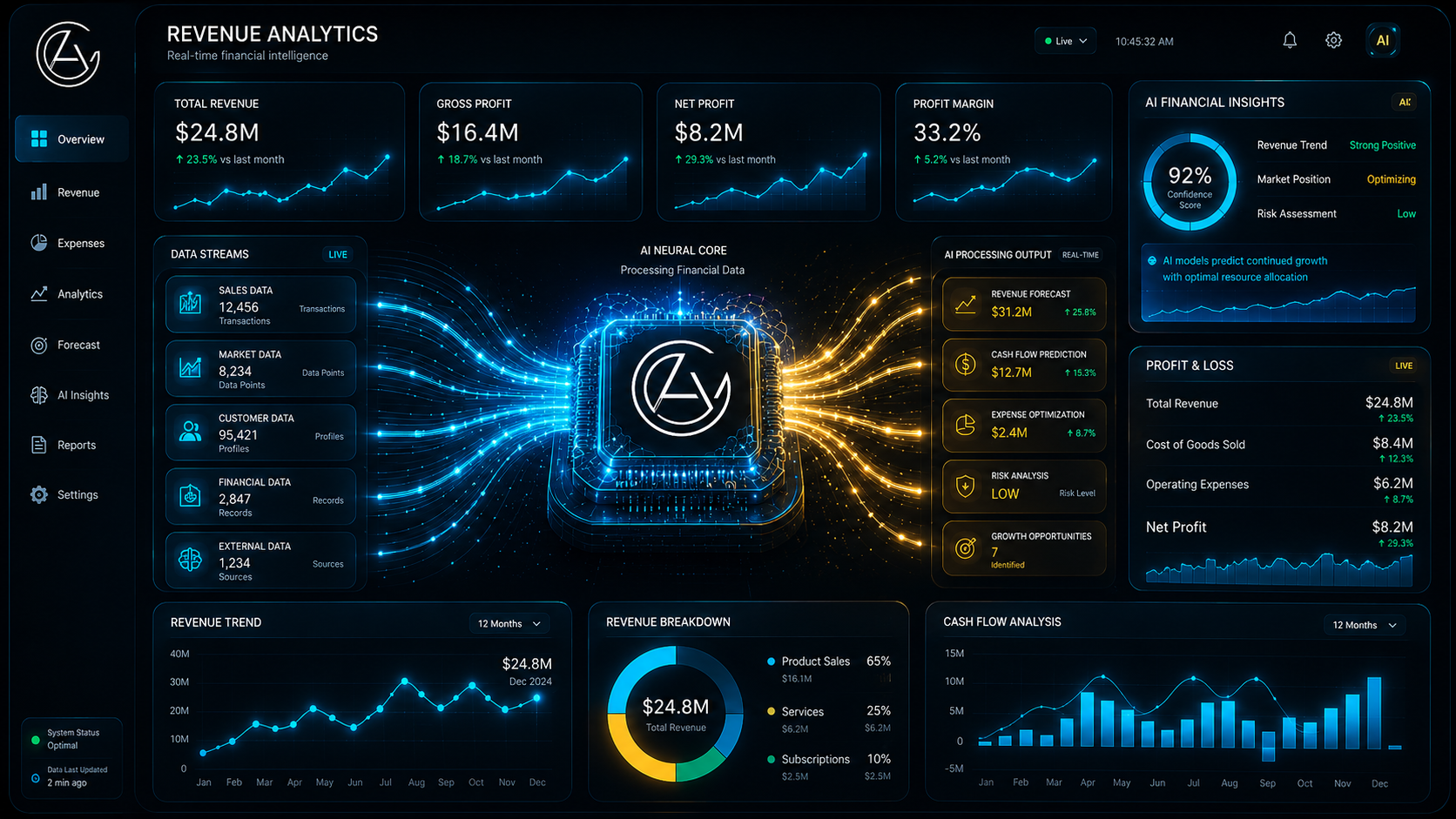
Every founder I talk to in 2026 has the same confession buried somewhere in the conversation: they don't actually know where their money is going until it is already gone. They stare at Stripe dashboards, cross-reference Google Ads spend in a spreadsheet, and pray that their monthly burn doesn't silently eclipse their MRR. It is the dirtiest open secret in the builder economy. We have mass access to AI, yet most of us are still running our finances on vibes.
I refused to operate like that inside the AhteVerse. When I started scaling multiple revenue channels -- digital products, ad monetization, affiliate funnels, and service contracts -- I realized that no single analytics tool gave me a unified, real-time view of profitability across all of them. Google Analytics tells me what happened yesterday. Stripe tells me what settled last week. Neither of them tells me what is about to happen tomorrow.
So I built something that does. I call it the Revenue Intelligence Engine. It is not a dashboard. It is not a report. It is an autonomous, agentic system that continuously ingests payment data, ad performance metrics, and operational costs, runs them through a RAG-augmented prediction pipeline, and surfaces actionable intelligence before the numbers even hit my bank account. In this guide, I am going to break down the exact architecture so you can build one yourself.
Conceptual Architecture Blueprint
graph LR
    User["Trigger Event"] -->|Inbound Webhook| Gate("Active n8n Gateway")
    Gate -->|Cognitive Processing| Validator{"AI Validation Node"}
    Validator -->|Pass| CRM["Autonomous CRM Sync"]
    Validator -->|Fail| Alert["Slack Emergency Escalation"]

    classDef default fill:#111,stroke:#333,stroke-width:1px,color:#fff;
    classDef highlight fill:#1d2d44,stroke:#00e5ff,stroke-width:2px,color:#fff;
    class Gate highlight;
Why Traditional Analytics Fails Founders in 2026
The fundamental problem with legacy analytics is latency. By the time you see a revenue dip in your standard BI tool, the damage is already done. You have already spent the ad budget. You have already shipped the campaign. You are looking at a rearview mirror and calling it strategy.
In my experience, the founders who are winning right now have shifted from hindsight analytics to foresight intelligence. The difference is architectural. Hindsight systems query historical databases and render static charts. Foresight systems ingest live transactional signals, compare them against historical vector embeddings, and generate probabilistic forecasts before the billing cycle even closes.
This is the core principle behind everything I built. The system does not wait for you to ask a question. It proactively surfaces anomalies, predicts revenue trajectories, and recommends budget reallocations autonomously.
The Architecture: Four Layers of Revenue Intelligence
The Revenue Intelligence Engine I deployed inside the AhteVerse operates across four distinct layers. Each layer feeds the next, creating a continuous cognitive loop that gets smarter with every transaction it processes.
Layer 1: The Data Ingestion Mesh
The first layer is the ingestion mesh. This is where all revenue signals enter the system. I pull from five primary sources:
- Payment processors (Stripe, PayPal) via webhook listeners that capture every charge, refund, and subscription event in real time.
- Advertising platforms (Google Ads, Meta Ads) via scheduled API polling that retrieves cost-per-click, impression data, and conversion attribution every 15 minutes.
- Affiliate networks via batch API pulls that reconcile commission earnings against referral traffic.
- Operational cost feeds (server bills, SaaS subscriptions, contractor invoices) ingested from structured CSV exports and bank API integrations.
- Product analytics (page views, funnel drop-offs, cart abandonment rates) streamed from the AhteVerse's internal event tracking layer.
The critical design decision here is normalization. Every data source speaks a different language. Stripe sends amounts in cents. Google Ads reports costs in the advertiser's currency. Affiliate networks delay reporting by 48 hours. The ingestion mesh transforms everything into a unified schema -- a standardized JSON payload with consistent currency conversion, timestamp normalization, and source tagging -- before anything enters the intelligence layer.
I run this on an n8n workflow that triggers on webhook events and scheduled intervals. If a Stripe charge fires at 3 AM, the mesh captures it instantly and routes it downstream. No batching. No waiting for tomorrow's report. For the technical specifications of n8n's webhook and scheduling nodes, see the official n8n Workflow Automation Documentation.
Layer 2: The Vector Memory Store
Raw numbers are useless without context. A $500 revenue spike means nothing if you don't know that last Tuesday you ran a flash sale and the same spike was followed by a 40% refund wave. This is where the vector memory store comes in.
Every processed transaction, along with its surrounding context (the campaign that drove it, the time of day, the customer segment, the product category), gets converted into a high-dimensional vector embedding and stored in a dedicated vector database. I use Pinecone for this, though Weaviate and Milvus are solid alternatives. For a deep dive into how semantic similarity search works at scale, the Pinecone Vector Database Architecture Guide is the best technical reference available.
The vector store serves as the engine's long-term financial memory. When new data arrives, the system performs a semantic similarity search against historical patterns. It asks: "Have we seen a revenue pattern like this before? What happened next?" This is fundamentally different from SQL queries. SQL asks for exact matches. Vector search finds behavioral similarities across thousands of dimensions that a human analyst would never notice.
For example, last month my engine flagged a pattern: ad spend on a specific campaign cluster was increasing linearly while conversion revenue was plateauing. A traditional dashboard would have shown two separate, healthy-looking charts. The vector search caught the divergence because it matched against a historical embedding from three months prior where the same pattern preceded a 22% margin erosion. I killed the campaign spend immediately and redirected the budget. That single intervention saved me roughly $1,200 in wasted ad spend over two weeks.
Layer 3: The RAG Prediction Core
This is the brain. The Retrieval-Augmented Generation layer takes the real-time ingestion data, retrieves the most relevant historical context from the vector store, and feeds both into an LLM to generate predictive intelligence.
Here is how the flow works in practice:
- A new batch of payment and cost data arrives from Layer 1.
- The system computes a current "revenue state vector" representing the aggregate financial position across all channels.
- This state vector is used as a query against the vector store, retrieving the top-K most similar historical states.
- The retrieved states, along with their outcomes (what happened to revenue in the 7, 14, and 30 days following those historical states), are injected into a structured prompt.
- The LLM synthesizes a forecast: projected revenue trajectory, confidence interval, identified risk factors, and recommended actions.
The critical difference between this and a standard ML forecasting model is explainability. When my engine tells me that projected ad revenue for the next two weeks is trending 15% below target, it doesn't just output a number. It cites the specific historical patterns it matched against, the exact campaigns showing underperformance, and the recommended budget adjustments. Every prediction comes with a citation trail back to real data. No hallucinations. No black boxes.
I have found that grounding the LLM with RAG eliminates the biggest risk of using AI for financial decisions: fabricated confidence. Without retrieval augmentation, an LLM will happily generate a convincing revenue forecast from thin air. With RAG, every claim is anchored to your actual transactional history.
Layer 4: The Agentic Action Layer
Intelligence without action is just entertainment. The fourth layer is where the Revenue Intelligence Engine transitions from passive analysis to autonomous execution.
Based on the predictions and recommendations from Layer 3, agentic workflows execute pre-approved actions:
- Budget Reallocation: If a paid campaign's predicted ROAS drops below a threshold, the agent automatically pauses spend and redistributes the budget to higher-performing channels.
- Pricing Adjustments: For digital products, the agent can trigger promotional pricing or bundle offers when it detects demand softening in specific customer segments.
- Alert Escalation: For high-severity anomalies (unexpected refund spikes, payment processor failures, sudden traffic drops), the agent dispatches encrypted alerts to my command channel with full diagnostic context.
- Forecast Reports: Weekly and monthly intelligence briefings are auto-generated and deposited into the AhteVerse operations dashboard -- no manual report building required.
The key constraint I enforce is human-in-the-loop governance. The agent can pause ad spend and trigger alerts autonomously. But it cannot increase spend, change product pricing above 20%, or modify subscription terms without my explicit approval. This boundary prevents the system from over-optimizing into a local maximum while ignoring strategic context that only a human operator can hold.
The Stack: What Powers This Locally
For builders who want to replicate this, here is the actual technology stack I run:
- Ingestion: n8n (self-hosted) for webhook listeners and API polling workflows.
- Normalization: Custom Python scripts running inside n8n Code nodes for currency conversion and schema transformation.
- Vector Store: Pinecone (managed) for embedding storage and similarity search.
- Embeddings: OpenAI's text-embedding-3-large model for converting financial state objects into vectors.
- Prediction LLM: Claude or GPT-4o, depending on the inference cost and context window requirements of the specific prediction task.
- Action Layer: n8n workflows triggered by prediction outputs, with conditional branches for autonomous vs. approval-required actions.
- Database: PostgreSQL for structured transaction logging and audit trails.
The total operational cost for running this system is under $80/month, which is negligible compared to the thousands it has saved me in wasted spend and missed revenue opportunities. If you want pre-built workflow templates to accelerate your own revenue intelligence stack, the Smart AI Business Kit includes production-ready n8n blueprints for payment monitoring and lead scoring.
What This System Cannot Do
I want to be transparent about the boundaries. This system excels at pattern recognition across your own historical data. It does not predict macroeconomic shifts, competitor moves, or platform policy changes. If Google suddenly changes its Ads algorithm or Stripe introduces a new fee structure, my engine will detect the downstream revenue impact quickly, but it won't predict the policy change itself.
It is also only as good as the data you feed it. If your payment processors have inconsistent webhook deliveries, or your cost feeds are manually updated once a month, the prediction quality degrades proportionally. Garbage in, garbage out still applies, even with the most sophisticated RAG pipeline.
The Bottom Line: Build Your Financial Nervous System
The reason I built this is simple. I wanted to stop being surprised by my own finances. Every builder operating at scale deserves a financial nervous system that feels signals before they become crises. The era of monthly P&L reviews is over. In 2026, if your revenue intelligence isn't real-time, contextual, and agentic, you are flying blind while your competitors are flying with radar.
The architecture I outlined here is not theoretical. It is running right now inside the AhteVerse, processing every transaction, every ad dollar, and every product sale through a continuous intelligence loop. And it is the single most impactful system I have deployed this year.
Stop looking at dashboards. Start building engines. The data is already there. You just need to teach a machine to think about it the way you would -- if you had infinite time and perfect memory.
Stay active. Stay sovereign. Keep building.