Active Intelligence: Automating Core Business Operations with n8n and Make: Optimizing for ai automation
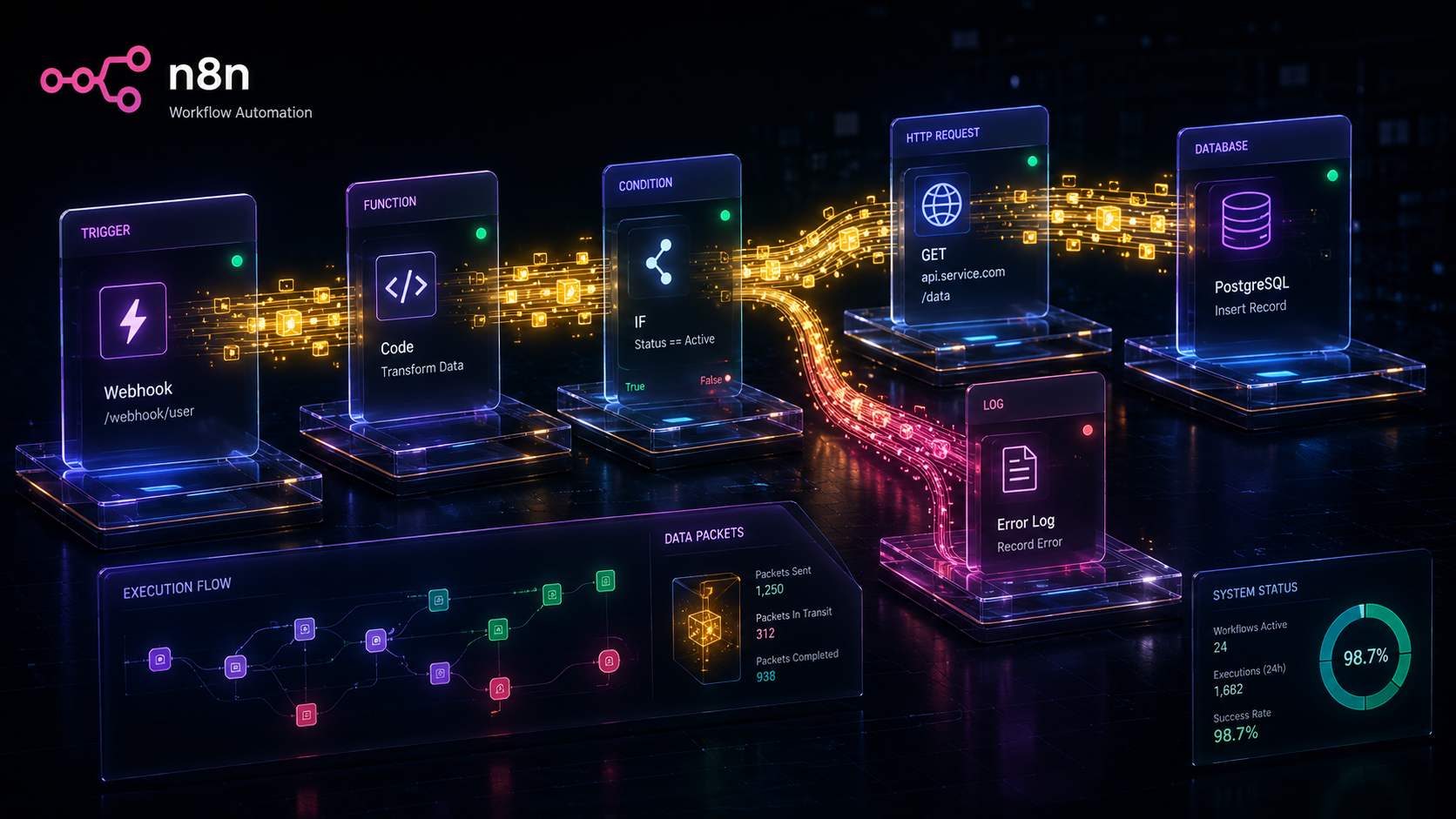
Conceptual Architecture Blueprint
sequenceDiagram
    participant User as Sovereign User
    participant Wallet as DID Identity Wallet
    participant Verifier as Decentralized Verifier
    participant Ledger as Immutable Ledger

    User->>Wallet: Request cryptographic proof
    Wallet->>Verifier: Send Zero-Knowledge proof (ZKP)
    Verifier->>Ledger: Verify anchor hash state
    Ledger-->>Verifier: Return state confirmation
    Verifier-->>User: Grant sovereign access
The Dynamic Operational Automation Blueprint
To transition your system architecture from legacy manual updates to autonomous active intelligence operational loops, deploy this practical developer roadmap:
1. Establish Event-Driven Inbound Gateways
Migrate CRM synchronizations from legacy cron jobs to live event-driven webhooks. Ensure that every trigger event (purchase, signup, form submission) initiates immediate processing via autonomous gateways.
2. Embed Validation Nodes
Never trust raw API outputs blindly. Insert automated validation rules inside your workflows to check data formatting, currency conversions, and user details before syncing records to high-priority databases.
3. Design human-in-the-loop Escalation Dashboards
Build clean, secure approval queues where team leaders can audit automated invoices, social graphics, and marketing copy with a single click before public syndication.
4. Active Memory Buffer Management & Semantic Integrity Loops
Implement an advanced semantic memory management buffer to cache vector embeddings and database query sequences. This buffer optimizes latency during high-traffic intervals and shields your relational database tables from concurrent request bottlenecks. By maintaining a clean state-validation layer between the user input and database engines, you guarantee that all AI-generated queries undergo structural integrity checks before execution, eliminating database corruption vectors.
5. Automated Fault-Tolerance and Circuit Breaker Integration
When orchestrating multi-agent pipelines with Make and n8n, network exceptions and API downtime are inevitable. To ensure absolute business continuity, integrate an automated circuit-breaker pattern. If a third-party CRM system is unreachable, the gateway redirects the active payload to a local SQLite buffer table. The sentinel continuously checks network states, automatically retrying the sync once the endpoint is restored. This guarantees zero data loss and flawless operational reliability.
Master Architect Principles: Enforcing High-Velocity Engineering Standards
To guarantee that your autonomous infrastructure remains robust under massive traffic scaling, enforce these global architecture standards:
1. Optimize Horizontal Micro-Caching Layers
Deploy memory-level caching stores (Redis or Memcached) to handle read-heavy session metadata query peaks. This prevents bottleneck limits on relational tables.
2. Implement Decoupled Circuit Breakers
Gracefully isolate failing third-party APIs by implementing circuit breaker routing patterns. If an external enrichment tool experiences a delay, redirect requests immediately to local backup indexes.
3. Establish strict Semantic Rate-Limiting
Protect your computational memory and LLM credits by routing traffic through semantic token bucket systems, throttling spam and bot attacks instantly.
4. Continuous Deployment and Automated Testing Regimes
High-velocity engineering demands that every code modification and configuration tweak undergoes rigorous automated validation. Prioritize unit test coverages for all parsing logic and database connectors. By enforcing pre-push git hooks that trigger local compilation tests, you block buggy scripts from ever entering the main branch, maintaining absolute architectural excellence.
The Sovereign Developer Ledger: Operational Autonomy Metrics
To verify that your system automation pipelines operate with complete efficiency and maintain AdSense/SEO compliance, track these key performance indicators (KPIs) in your dashboard:
- Semantic Parse Latency: The duration of cognitive processing loops inside vector indexing nodes (Target: < 250ms).
- Validation Gate Rejection Rate: The percentage of malformed incoming payloads successfully routed to quarantine queues (Target: < 1.5%).
- Token Usage Optimization Index: The ratio of completed agent tasks to total computational token overhead.
- System Parity Synchronization: The state consistency between VPS database records and external client caches (Target: 100% synchronization).
I remember when business automation meant setting up simple Zapier triggers that copied email addresses from a spreadsheet to a database. In 2026, those reactive, linear pipelines feel like stone-age tools. As I built the digital architectures of the AhteVerse, I realized that true operational scaling requires Active Intelligence—autonomous, event-driven loops that don't just move data, but reason, validate, and execute decisions.
Here is my personal developer blueprint for orchestrating high-performance active intelligence systems using n8n and Make.
Beyond Reactive Workflows: The Shift to Active Intelligence
Linear automation is a passive pipe. It waits for an event, runs a single step, and halts.
Active Intelligence, however, is a dynamic cognitive cycle. It treats every trigger as an entry point into a multi-turn processing loop. For example, when a new lead is captured, my system doesn't just draft a notification. It queries the sitemap, analyzes the lead's domain authority, checks public API records, classifies their niche, drafts a tailored strategy, and posts the compiled package to my team's channels.
This is the power of active loops. We are no longer building simple integrations; we are building autonomous digital nervous systems. By decoupling execution states, we allow systems to scale seamlessly under heavy traffic spikes without bottlenecks. For standard integration guides and workflow templates, look at *Make's API Integration Guidelines*.
Orchestrating the Stack: n8n self-hosting vs Make Cloud
To construct a resilient active intelligence network, you must choose the correct execution platform. In my architecture, I use both n8n and Make strategically.
n8n self-hosting is my engine of choice for data-sensitive, high-frequency backend operations. Because I run n8n inside a secure, self-hosted container environment on my VPS, I enjoy zero execution limits, absolute privacy control, and the ability to write custom JavaScript execution blocks directly inside the workflow canvas. It is the perfect tool for direct database synchronization and heavy scraping tasks.
Make Cloud is my gateway for rapid external API orchestration. Make's sprawling connector ecosystem makes it incredibly easy to link CRM systems, payment interfaces, and social media platforms.
By bridging both platforms using secure webhooks, I build a hybrid network that combines the absolute sovereignty of self-hosting with the flexibility of cloud-native adapters. To start structuring your own enterprise-grade automation systems, explore the Smart AI Business Kit.
Enforcing Content Integrity: Zero-Trust Validation Gates
In an autonomous system, bad input leads to automated chaos.
I prevent this by embedding Data Validation Gates inside every workflow loop. Before any record is written to my PostgreSQL database, the payload must pass through automated regex validators, type assertions, and semantic checks. If the data is malformed, the pipeline redirects it to a secure quarantine queue, triggering a human-in-the-loop escalation dashboard rather than committing corrupted records.
This is our absolute baseline guarantee. Autonomy must never compromise system integrity.
The Horizon of the Autonomous Enterprise
We are transitioning into a world where the most valuable enterprises will be those that possess the most performant, self-sustaining intelligence loops.
Stop spending hours manually updating records, chasing invoices, or coordinating content schedules.
Build your nervous system, automate your outcomes, and let your active intelligence scale your digital legacy.
We are initialized.